
Why High-Quality YouTube Channels Stay Small
A breakdown using the “Productive Setups” channel as a case study
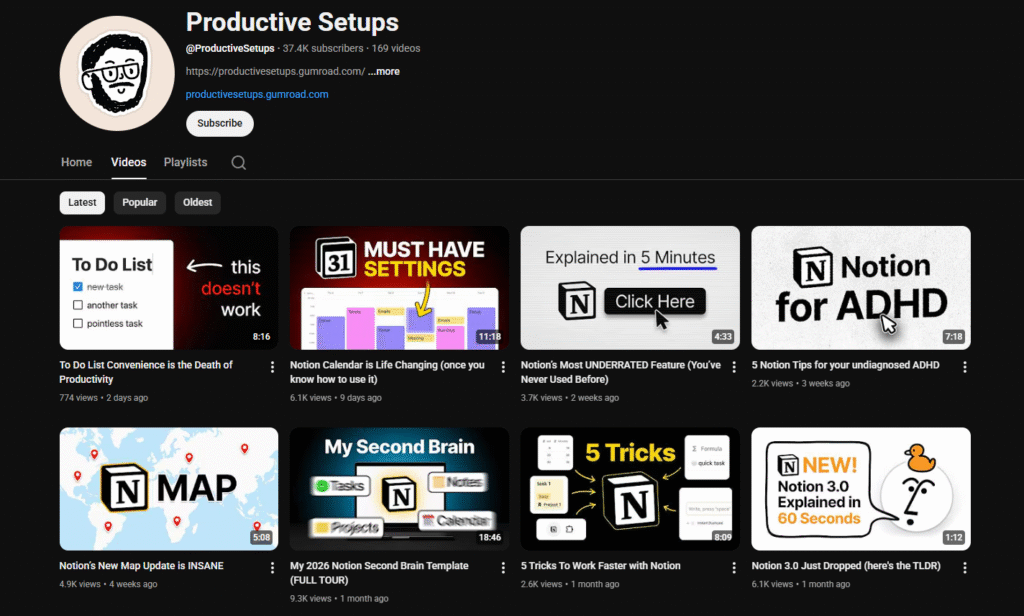
You open a channel like Productive Setups and it feels off:
- ~37k subscribers
- Clean thumbnails
- Well-produced Notion/productivity videos
- Yet many uploads are sitting in the 2k–6k view range
If the videos clearly aren’t trash, why aren’t they pulling bigger numbers?
The answer is that YouTube’s system doesn’t reward “quality” in the way most people think. It rewards specific behaviors, and a creator can be doing a lot of things right while still limiting their reach.
Let’s dissect this step by step.
1. His views are not actually “bad” for his size
From the screenshot:
- 1 day ago: ~733 views
- 8 days ago: ~6k views
- 2 weeks ago: ~3.7k views
- 3 weeks ago: ~2.2k views
- Subscribers: ~37.4k
A rough way to judge health is:
views on a typical recent video vs. total subscribers.
For many educational or niche channels, a “healthy” range is roughly 8–14% of subscribers watching a normal upload (huge spikes happen when a video breaks out of the niche, but you can’t treat those as baseline).
By that crude yardstick:
- 6k views / 37.4k subs ≈ 16% → above typical
- 3.7k / 37.4k ≈ 10% → solid
- 2.2k / 37.4k ≈ 6% → slightly under
- 733 after one day → still in “too early to judge” territory
So the numbers look small only because you’re comparing them to large creators and to the raw sub count. In the context of a narrow productivity software niche, this is actually normal performance.
The real issue isn’t “why so few views?” but “why doesn’t a clearly competent creator break out more often beyond their core audience?”
That’s where the algorithm and niche dynamics come in.
2. YouTube doesn’t care if your video is “good” – it cares if it keeps people on YouTube
When creators and viewers say quality, they usually mean things like:
- good audio and lighting
- clear editing and pacing
- valuable, accurate, well-structured information
- thoughtful thumbnails and titles
YouTube’s recommendation system doesn’t evaluate any of that directly. It’s effectively blind to effort and intentions. What it sees is:
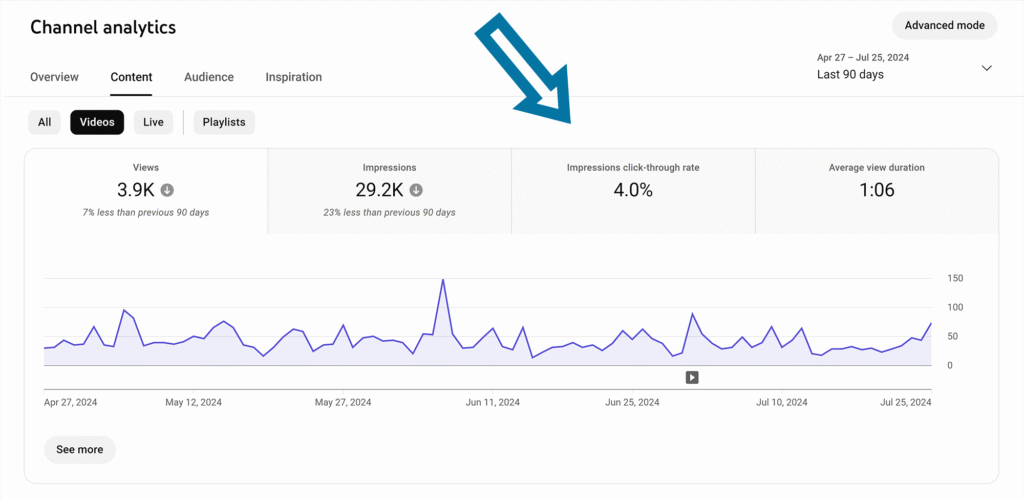
- Click-through rate (CTR) – of all the people who saw the thumbnail/title, how many clicked?
- Watch time and retention – how long did they keep watching, and what percentage did the average viewer complete?
- Session impact – did this video cause the viewer to watch more videos on YouTube, or did they leave?
- Negative signals – “not interested”, short clicks and bounces, etc.
You can have excellent production values and very useful content, but if:
- the topic only appeals to a small group, or
- the title/thumbnail doesn’t trigger curiosity strongly enough, or
- the opening 30–60 seconds are slow
…YouTube will put its promotion energy behind someone else instead.
So you end up with a channel that feels like a hidden gem: quality work, moderate but not explosive reach.
3. The niche is narrow and high-intent, not mass-market
Look at the topics visible on the channel:
- “To Do List Convenience is the Death of Productivity”
- “Notion Calendar is Life Changing (once you know how to use it)”
- “Notion’s Most UNDERRATED Feature”
- “5 Notion Tips for your undiagnosed ADHD”
- “My 2026 Notion Second Brain Template”
To watch these, a viewer must:
- Already be using Notion (or be very close to trying it)
- Care about workflow optimization
- Be willing to watch a 5–18 minute breakdown for a marginal improvement to their setup
That’s a small funnel compared to:
- general productivity (“How I plan my week”)
- self-improvement (“I tried waking up at 4:30 a.m. for 30 days”)
- entertainment-productivity hybrids (“I let subscribers control my schedule for a week”)
In other words, this is high-intent, low-volume traffic.
If a video hits 5–10k views with that positioning, it might already be reaching a huge percentage of the reachable audience for that specific topic in a given time window.
From a business standpoint, that can be more than enough—especially if each view is from a motivated, tool-obsessed knowledge worker who is willing to buy templates or courses. But from a “why isn’t this 100k views?” emotional standpoint, it feels underwhelming.
4. Subscriber count is a misleading metric
Another reason it looks like he has “low” views: you’re comparing to his subscriber count.
But:
- Subscriptions are cheap and sticky. People sub, then change jobs, switch apps, lose interest, or simply never see the channel again in their feed.
- A chunk of his subs probably came from older content or different topics (maybe more general productivity, setups, or different tools). Those people might not care about deep Notion tutorials today.
So his true active audience for the current content might be something like:
- loyal fans who watch every upload
- occasional viewers who click when the topic hits their exact use-case
- search-based viewers finding individual videos via Google/YouTube
From that perspective, 2k–6k views per focused video is not a failure; it’s just the real, cleaned-up number of people who still care about his current niche.
Treat subs as a historic artifact, not a real-time measure of interest.
5. Packaging: accurate tutorials vs. curiosity-driven hook
His thumbnails and titles are generally solid, but they are still primarily tutorial-style:
- “Notion Calendar is Life Changing (once you know how to use it)” – strong claim, but targeted
- “To Do List Convenience is the Death of Productivity” – interesting, but conceptual
- “Notion’s Most UNDERRATED Feature (You’ve Never Used Before)” – classic YouTube phrasing, but inside a narrow tool niche
The value proposition is clear: “learn this specific thing; your productivity improves.”
What’s missing—if the goal is breakout growth—is:
- broader curiosity hooks that even non-Notion users might click
- emotional stakes (challenge, transformation, story)
- “I need to see how this ends” framing
For example, compare:
- “Notion Calendar is Life Changing (once you know how to use it)”
vs. - “I rebuilt my entire life in a calendar – here’s what broke”
The second one reaches a wider audience first, then introduces the tool as part of the story. It has a chance to escape the Notion niche; the first one remains firmly inside it.
Nothing wrong with that—if his business is built on selling Notion templates, staying inside the niche might even be the correct strategic choice. But it limits view potential by design.
6. Retention and the first 60–90 seconds
We can’t see his analytics, but here’s how this usually plays out for channels like his:
- The viewer clicks because they want Notion tips.
- The intro spends 30–60 seconds on context: why this matters, what Notion is, some “if you’re new here…” channel boilerplate.
- Only after that does the video get into the real meat.
Even if everything is well-edited and clear, some portion of viewers will:
- skip ahead
- get distracted
- leave the video
YouTube sees that as weaker retention compared to videos that slam the viewer with immediate payoff:
- “Here’s the calendar setting that will save you hours. Let me show it to you in the first 15 seconds.”
Educational creators tend to over-explain, under-hook. The result: quality but slightly “slow” videos that underperform in recommendations compared to more aggressively structured content.
7. Strong business, modest vanity metrics
Now look at the actual product side, not just the YouTube numbers.
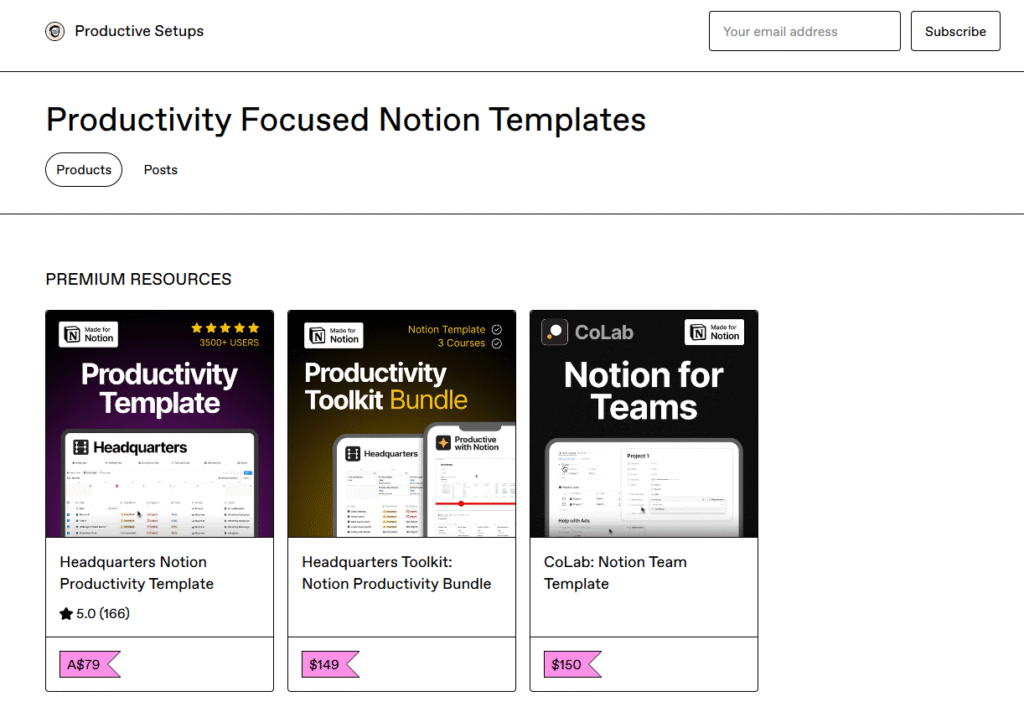
From his Gumroad page you can see:
- A flagship “Productivity Template” with
- 3500+ users
- 5.0 rating from 160+ reviews (166 shown)
- Price tag around A$79
- Higher-ticket products:
- Productivity Toolkit Bundle – $149
- Notion for Teams – $150
That tells you a few concrete things:
- This isn’t a hobby; it’s a working product business.
A template sitting at 3500+ users × A$79 implies hundreds of thousands of dollars in gross revenue over its lifetime, even before you account for bundles, team templates, discounts, fees, or older pricing. Even if you haircut that number aggressively for sales, coupons, and earlier lower prices, you’re still very comfortably into “serious income,” not pocket money. - His “small” views are feeding a high-value funnel.
Think about a single Notion video doing 6,000 views:- Suppose 3% of viewers click through to his product page → 180 visitors
- Suppose 5–10% of those buy something (flagship template, bundle, or team product) → 9–18 buyers
- At $79–$150 per product, that’s easily $700–$2,000+ in revenue from one video’s initial run, plus whatever it continues to bring in via search over months or years.
- The important metrics aren’t public.
What matters to him is likely:- Email subscribers added per video
- Template sales and bundle upgrades
- Lifetime value (LTV) of someone who discovers him via one tutorial and then buys multiple products
- Chasing bigger views could actually weaken the business.
If he pivots into broad, click-chasing topics just to inflate view count:- He pulls in casual, low-intent viewers who will never buy a $79 template.
- YouTube starts recommending his future uploads to that diluted audience instead of the hardcore Notion/productivity crowd.
- His views go up, but conversion rate and revenue per view go down.
So those “small” numbers on YouTube are misleading. When you line them up next to:
- 3500+ paying users
- High-ticket templates and bundles
- Long-tail search traffic that keeps selling old videos’ products on autopilot
…it stops looking like an underperforming channel and starts looking like a deliberately tuned lead engine. In that context, low vanity metrics are just the cost of playing in a tight, high-intent niche—and the business case still works.
8. What you should actually learn from this (if you’re a creator)
Instead of thinking “if even he can’t get big views, YouTube is broken,” the better takeaway is:
1. Separate craft quality from algorithm performance
- Great audio, editing, and insights are baseline for serious channels.
- Growth comes from topic selection, packaging, and retention, not just “making good stuff.”
2. Optimize for the right metric for your strategy
- If you’re selling a product, you want high-intent, niche viewers, not random virality.
- If you want to become a personality brand, you’ll need to push into broader topics and emotional hooks, not just polished tutorials.
3. Treat subscriber count as background noise
- Judge your performance by views per recent video, CTR, retention, and income per video.
- Ignore the illusion that 100% of your subs should be watching every upload. They won’t.
4. Decide: do you want to be a sharp niche tool… or a big general-purpose brand?
Productive Setups looks like a creator who chose:
“Be the go-to Notion/second-brain guy for people who actually care enough to pay.”
That path can absolutely coexist with “only” a few thousand views per upload—and still be a very successful business.
Closing thought
This channel isn’t “small with quality videos.” It’s:
- a specialized, monetized operation
- with normal to strong performance for its niche
- that looks small only when judged by entertainment-channel standards
If you want to understand YouTube realistically, stop asking:
“Why is this high-quality creator not huge?”
and start asking:
“Given the niche, packaging, and strategy, is this channel actually doing exactly what it’s designed to do?”
In the case of Productive Setups, the honest answer is: probably yes.